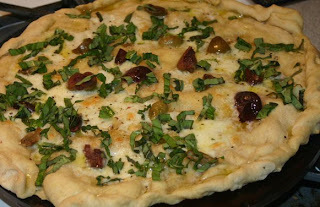
I’m hungry! Too hungry to write or to think or to do anything that doesn't involve eating. I long to be nourished and will soon be on my way… after the pizza’s out of the oven. 15 minutes later…crisis averted. First bite taken and I’m finding ecstasy in a mass of utter imperfections! Look at that crust- lop-sided, nowhere near round, and most definitely not of an even thickness. Normally, I would be disappointed, but not today. Today… bliss. Yumm! This is why people have been eating olives since the beginning of civilization. I am nourished.
“I’m So Starving Feed Me Olives Pizza”
For the dough (personally modified from Alice Waters’ The Art of Cooking):
2 Tsp Yeast
¼ cup luke-warm water
¼ cup Rye flour
3 ¾ cup white spelt or unbleached all purpose flour
¼ cup extra virgin olive oil
¾ cold water
Pinch of salt
For the rest:
1 fresh mozzarella ball
1 handful of your favorite olives, pitted and cut in half or quartered
¼ cup fresh basil (or your favorite herb like parsley or thyme), roughly chopped
Extra virgin olive oil
Salad and dressing:
I head of Red Leaf, your favorite lettuce, or a salad mix
1 tsp Dijon mustard
1 Tbs red wine vinegar, white wine vinegar, or apple cider vinegar
3 Tbs Extra virgin olive oil*
1 Tbs minced shallot
A large pinch of chopped basil
Salt and pepper to taste
*The vinegar (meaning acid) to oil ratio is 1:3, so if you’re making less or more, you can adjust the amounts accordingly. Also, you can use any vinegar or acid (such as lemon juice) that you like.
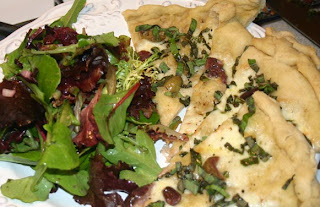
I. The Dough
*Your dough will need at least 3 hours to fully develop. I recommend making it the evening before and letting it rise overnight in your fridge.
** This dough will make either two 9 in round pizzas, or 1 long 18 in rectangular focaccia.
1. Put the yeast and ¼ cup warm water in a large bowl and leave alone until the yeast has dissolved- about 5 minutes.
2. Make the “Sponge” (yeast and a little bit of flour) by adding ¼ cup Rye Flour and ¼ cup white flour to the dissolved yeast and mix together until the lumps are gone. Using a wooden spoon is recommended and feels more professional, but it’s easier to get a smooth mixture with a whisk, although that adds extra air, so do whichever you prefer- the taste is the same either way.
3. Now cover the bowl with a clean towel, put it somewhere warm, and leave the sponge alone to develop for at least 20 minutes and up to an hour. This will allow the yeast to ferment and develop a truly lovely flavor and aroma. When the sponge is completely bubbly, then it’s ready for the next step.
4. Add the rest of the flour, ¼ cup olive oil, ¾ cup water, and salt. Mix together with a spatula or wooden spoon until the dough begins to form a ball, then plop it out onto a floured surface and knead for 5-20 minutes until the dough becomes elastic; when you press your finger into it and the depression bounces back- you’re done. It will look round, lovely, and you’ll say to yourself, “that’s exactly what a ball of dough should look like!”
5. Put the dough ball into a clean bowl that’s been coated with olive oil. Give the dough a twist and then turn it over so that the entire surface of the ball is coated with oil. Cover with plastic wrap and a towel and put it somewhere warm until the dough has doubled in size- about 1 hour.
6. After it’s doubled, punch the dough down in the middle to re-distribute the yeast, cover, and let continue to rise for either another 2 hours or overnight in the fridge.
II. The Pizza
*To make this an entirely vegan meal, omit the cheese, add some chopped rosemary or thyme or combo thereof, and double the amount of olives.
** If you have a baking stone, be sure that it is preheated and that your peel (a paddle-like tool made out of wood used to maneuver breads and pizzas in and out of the oven) is coated with cornmeal or flour so that the dough does not stick. If you do not have a baking stone, use a pre-heated metal sheet pan and be careful not to burn yourself.
1. When you’re ready to make the pizza or focaccia, cut the dough ball in half (or leave whole for 18 in focaccia) and stretch the dough to the desired size by making a fist, laying the dough over the back of your fist, and pulling lightly then rotating the dough around your fist until the desired size is reached. You can also flatten the dough on the surface, push it outward with your fingers, and then pull lightly from the edges. Do not use a roller; otherwise you will push out all of the air that makes the bread light and heavenly.
2. Preheat oven to 400 and add the stretched dough drizzled with olive oil, cheese, and olives for about 10-13 minutes or until the cheese has lightly browned. Remove and add the chopped basil immediately, then add fresh ground pepper and drizzle with olive oil.
III. The Salad Dressing:
1. Mix mustard and vinegar together then slowly whisk in the olive oil. Add minced shallot, basil, and salt and pepper to taste. Toss with the greens.
Super lengthy instructions, I know, but you’ll get the hang of it and I promise that the end result is well worth the work! I also recommend keeping a dough ball in the fridge so that you can easily make a pizza or focaccia when you get home at the end of a long day. Let me know if you have any questions and remember to pour a glass of wine, sing your favorite song, and enjoy the process of nourishing your stomach and your soul.
Happy Eating!
- Andreya





 Posts
Posts


